
Master’s Research Project

Bridging the Gap Between Students, Skills, and Jobs

NEXTGEN MINDS is a data-driven career guidance platform that helps students connect their education and skills to real-world job opportunities, while giving employers better visibility into job-ready talent.

Team: NEXTGEN MINDS Semester: Fall 2025

Meet the Minds of NEXTGEN MINDS

“Guiding students from confusion to clarity using data, not guesswork.”

Rajesh Bhukya

Rajesh Bhukya

CEO / Project Manager
Rajesh Bandari

Rajesh Bandari

Business Analyst

Srija Bakshi

Srija Bakshi

Technical Architect

Saathwika Sunkari

Saathwika Sunkari

Compliance & Research Officer

Haripriya

Haripriya

IT Solutions Analyst

Executive Summary

Students today navigate an incredibly noisy career landscape: hundreds of job titles, rapidly changing technologies, and generic career advice that often fails to connect classroom learning with real opportunities. Many students are unsure which roles they qualify for, which skills they should prioritize, and how to interpret job descriptions. At the same time, employers struggle to find candidates whose skills match their open positions, especially in fast-moving domains such as data, cloud, and software.

NEXTGEN MINDS addresses this gap by providing a lightweight but powerful career guidance platform built on top of familiar tools. The system combines a responsive web interface (hosted on GitHub Pages) with Google Sheets as the primary data store and Google Apps Script as a middleware layer. Students register, describe their skills and education, and explore jobs that are dynamically loaded from a structured jobs dataset. Dashboards built on this data reveal trends, skill gaps, and alignment between students and market demand.

The project showcases how thoughtful architecture and data design can turn simple technologies into an effective decision-support tool for students, employers, and academic advisors. It demonstrates end-to-end thinking: from problem definition and stakeholder analysis, through data modeling and synthetic dataset creation, to dashboards that communicate insights at a glance.

Ultimately, NEXTGEN MINDS is not just a class assignment; it is a portfolio-ready prototype that could be scaled into a real service to support students in planning their careers with clarity and confidence.

Problem Context & Stakeholders

Problem Overview

  • Students struggle to map their skills and degrees to specific job roles.
  • Job descriptions are often unclear about which skills truly matter.
  • Career guidance is frequently generic, not data-driven or personalized.
  • Employers have difficulty identifying candidates who are genuinely job-ready.

This leads to lost opportunities, misaligned applications, and anxiety for students who feel they are “stuck” despite having valuable skills.

Stakeholders

  • Students (10+2, undergraduate, graduate): need personalized career roadmaps, insight into skill gaps, and clarity about which roles match their profiles.
  • Employers: want a way to reach students whose skills and interests align with real job requirements.
  • Academic Advisors & Institutions: need tools to align programs, advising, and curricula with market trends.

NEXTGEN MINDS is designed at the intersection of these stakeholders, using shared data to create transparency and alignment.

Research & Insights

Our research combined informal interviews with students who were actively searching for internships and full-time roles, a review of job postings across common platforms, and analysis of the skills most frequently mentioned in entry-level roles. Students repeatedly expressed uncertainty about whether they were “ready” for specific jobs and which skills were worth investing time in.

From employers’ job postings, we extracted recurring patterns in required skills (e.g., Python, SQL, cloud platforms, problem-solving) and experience ranges. These qualitative insights were translated into a data model and then into synthetic datasets that approximate a realistic job market. This research directly informed our entities, attributes, and the metrics surfaced by our dashboards.

Proposed Solution

System Overview

NEXTGEN MINDS is a web-based platform that centralizes student profiles, job postings, and analytics into a single environment. Students can:

  • Register and store their education, experience, and skills.
  • Explore job listings filtered by skills, experience, and role interests.
  • View dashboards summarizing their alignment with the job market.
  • Discover recommended skills or courses to close identified gaps.

Employers are represented via structured job data in Google Sheets, making the system lightweight and easy to maintain.

Key Features

  • Student registration and login linked to Google Sheets backend.
  • Dynamic jobs page powered by a jobs dataset maintained in Sheets.
  • Skill-based matching and filtering logic on the frontend.
  • Performance dashboards showing skill gaps, demand, and match rates.
  • Contact form so students can reach out for support or feedback.

The solution demonstrates how everyday tools can be orchestrated into an integrated product without requiring heavy infrastructure.

Project Charter

Objectives

  • Design and implement a functional career guidance prototype.
  • Establish a scalable and clean data model for students, jobs, and employers.
  • Build dashboards that surface actionable insights for decision-making.

Scope & Deliverables

  • Responsive multi-page web application (NEXTGEN MINDS).
  • Google Sheets-based datasets with synthetic records.
  • Google Apps Script backend for communication with Sheets.
  • Dashboards summarizing skills, demand, and match metrics.
  • Project portfolio website (this page) for presentation.

Team Roles

  • Rajesh Bhukya – Project Manager & Lead Developer
  • Rajesh Bandari – Business Analyst
  • Srija Bakshi – Technical Architect
  • Saathwika Sunkari – Compliance & Research
  • Haripriya – IT Solutions & Analytics

Architecture & Data Design

Enterprise Architecture Diagram

The diagram below shows how presentation, application, and data layers interact to deliver the NEXTGEN MINDS experience for students, employers, and academic users.

Presentation Layer GitHub Pages UI (Student / Employer / Admin views) Application Layer Google Apps Script Web App (APIs, validation, routing) Data Layer Google Sheets (Students, Jobs, Employers, Contacts, Dashboard feeds)

ER Diagram

Conceptual overview of the relationships between Students, Academic Records, Applications, Employers, and Job Postings.
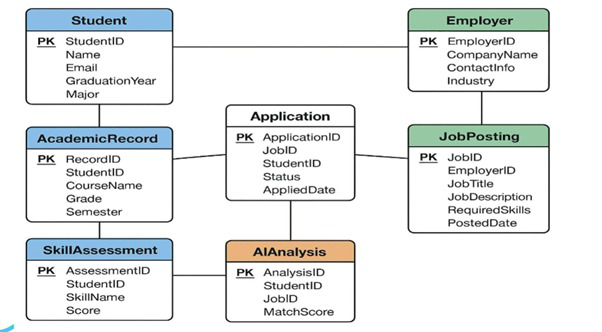
ER Diagram
STUDENT student_id, skills, edu_level EMPLOYER employer_id, company JOB job_id, title, skills_req CONTACT_MESSAGE name, email, subject applies / matches posts submits

Data Model (Sheets)

Students Sheet

  • user_id (PK)
  • role
  • first_name, last_name
  • email
  • education_level
  • experience_years
  • skills (comma-separated)
  • preferred_role
  • created_at

Jobs Sheet

  • job_id (PK)
  • employer_user_id
  • company_name
  • job_title, job_type
  • location
  • min_exp, max_exp
  • skills_required
  • description
  • required_edu
  • created_at, status

Employers & Contacts

  • employer_user_id (PK), company_name, email, password, created_at
  • Contact messages: name, email, subject, message, created_at

Data Flow Explanation

The data flow begins when a student registers or submits a form on the NEXTGEN MINDS frontend. The browser sends the request to Google Apps Script, which validates and writes the data into the appropriate Google Sheet (Students, Jobs, or Contacts). Dashboards and analytics read from these sheets to generate charts and insights.

Student / Employer Browser (UI) NEXTGEN MINDS UI GitHub Pages Google Apps Script Web App Endpoint Google Sheets Students / Jobs / Employers / Contacts Dashboards & Analytics Charts & KPIs click / form HTTP request read / write feeds aggregated insights

Data & Dataset Creation

To avoid privacy issues while still modeling realistic behavior, we built a synthetic dataset that reflects typical job-market structures. The dataset includes:

  • ~1000 synthetic student records with varied skills, education levels, and experience.
  • Hundreds of synthetic job postings across roles such as Data Analyst, Software Engineer, and Cloud Engineer.
  • Employers representing universities, startups, and larger companies.

We defined rules to maintain internal consistency — for example, more advanced roles require higher experience and education levels; technical roles include associated skill tags (e.g., Python, SQL, cloud); and location attributes mirror common job hubs. These rules ensure that the dashboards and match logic generate insights that feel realistic rather than random.

Dashboard & Data Analysis

Embedded / Linked Dashboard

The core dashboard is implemented in the NEXTGEN MINDS application and exposed via the performance page. It reads directly from the same Google Sheets that store student and job data.

Use the link below to open the live dashboard:

Open Performance Dashboard

Key Insights from Charts

  • Students with skills such as Python and SQL show the highest match rates for data-focused roles.
  • There is a visible gap in cloud and DevOps skills compared to the number of jobs requiring them, suggesting a strong upskilling opportunity.
  • Early-career students (0–2 years experience) cluster around internships and junior roles, while those with more experience align with mid-level jobs.

These insights support targeted recommendations: for example, encouraging students to invest in cloud certifications or advanced tooling to increase alignment with high-demand roles.

Ethical & Social Considerations

  • Privacy: We used synthetic data exclusively for testing dashboards and logic, ensuring no real student records are exposed.
  • Bias & Fairness: We intentionally balanced skills and roles across the dataset to avoid reinforcing stereotypes (for example, limiting certain technologies to specific groups).
  • Transparency: Matching and recommendations are based on clearly defined rules and visible attributes, not opaque black-box models.
  • Accessibility: The platform is web-based, lightweight, and aims to support students across different education levels and backgrounds.

Future work could include formal bias audits, user feedback loops, and better explanation interfaces that help students understand why particular jobs or skills are recommended.

Lessons Learned & Team Reflection

NEXTGEN MINDS was a hands-on learning experience in turning an abstract problem into a functional, data-driven product. As a team, we learned:

  • The importance of designing the data model before writing frontend or backend code.
  • How small integration details (like CORS, deployment, and API URLs) can block progress if not handled carefully.
  • The storytelling power of dashboards for communicating insights to non-technical audiences.
  • The value of clear role assignment and collaboration across research, architecture, development, and analytics.

Individually, each member developed skills in areas such as spreadsheet-based data engineering, Apps Script development, frontend design, and ethical analysis of technology. Overall, the project gave the team confidence to build end-to-end digital solutions grounded in data.

Appendix & Additional Resources

Live Application

Access the full NEXTGEN MINDS platform:

View NEXTGEN MINDS Live App

GitHub Repository

Source code for the web app and this portfolio site.

Open GitHub Repo

Datasets & Future Work

  • Students, Jobs, Employers, Contact sheets (synthetic data).
  • Planned: ML-based recommendation engine.
  • Planned: Deeper longitudinal tracking of student outcomes.